
%202%20(1).svg)

Trusted by













Trusted by


.svg)







Penetration Testing: Find the Gaps Before Hackers
Modern development is moving fast, especially with AI-powered tools like AWS Kiro IDE that can write code, run commands, and manage workflows.
But that speed comes with new risks.
Opening a project folder shouldn’t compromise your system. In 2026, it did.
In March 2026, a critical vulnerability (CVE-2026-4295) highlighted how simply opening a malicious project directory could trigger remote code execution (RCE) on a developer’s machine.
While not widely reported as exploited at scale, it exposed a dangerous class of issues in modern developer tools where local workflows, file handling, and automation features can be abused to execute code without explicit user intent.
The vulnerability effectively bypassed workspace trust boundaries, turning a routine action into a potential system compromise.
This wasn’t an isolated case.
A related issue earlier in 2026 showed how attackers could inject commands through manipulated workspace paths again leading to remote code execution.
The real problem wasn’t just the flaws.
It was how easily they could be triggered and how quickly they led to full compromise.
So the question is:
How do you identify these attack paths before attackers do?
This is where penetration testing comes in.
Penetration testing (pentesting) simulates real-world attacks to uncover exploitable vulnerabilities even before they turn into breaches.
This guide covers the pentesting process, the main types of tests, and the advanced methods for 2026.
Stop relying on annual pentests. See how Siemba combines AI, automation, and expert testers to validate real attack paths across your environment.
Key Takeaways
-
Penetration testing simulates real attacks to identify exploitable vulnerabilities in systems, applications, and processes.
-
It validates real-world risk, unlike vulnerability scans that only detect potential weaknesses.
-
Different IT assets, such as network, web/API, mobile, cloud, social engineering, and physical security, need to be tested.
-
It is a structured process (scoping, reconnaissance, exploitation, reporting, remediation) that ensures safe and effective testing.
-
Pentesting complements other security practices like vulnerability scanning, red teaming, and bug bounties.
-
Security testing is becoming continuous, integrated with DevSecOps and PTaaS platforms.
-
Combining different pentest types (black box, gray box, white box) with execution methods (expert-led, automated, and autonomous) provides more comprehensive and realistic coverage of potential vulnerabilities.
-
AI supports pentesters by speeding up reconnaissance and analysis, but does not replace human expertise.
What is Penetration Testing, aka Pentesting?
Penetration testing is a planned, authorized simulation of an attack on your systems, applications, or processes.
Its purpose is to find and safely test vulnerabilities, without disrupting the systems.
The aim is not to cause damage, but to see how real attackers might get in, gain more access, and cause security threats.
Good pentesting helps you:
- Find weaknesses that attackers could actually use.
- Check if your defenses work. Make sure your security controls, monitoring, and response processes act as they should during a real attack.
- Measure business risk by showing the impact, likelihood, and combinations of issues that really matter.
Penetration testing can cover technologies such as networks, web/mobile apps, and cloud workloads. It can also include people through social engineering and even physical access.
Remember, strong security programs use risk-based planning. They start by protecting the most valuable assets and key business processes first.
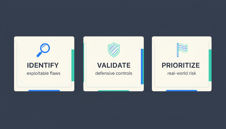
Pen Testing vs. Other Testing Methods
Penetration testing combines expert-led analysis with supporting tools to safely identify and validate exploitable vulnerabilities, assess their impact, and understand how attacks could happen.
Traditionally, organizations tested critical systems annually, quarterly, or before major releases. However, in 2026, many teams are moving toward continuous and trigger-based testing that aligns with how systems actually change, validating risk as new code is deployed, assets are exposed, or configurations evolve, rather than waiting for the next planned assessment.
Penetration testing is often compared with vulnerability scanning, red teaming, and bug bounty programs. Each serves a distinct purpose, and mature security programs use them together and not as substitutes.
|
Method |
Primary Goal |
Frequency |
Key Strength |
Approach |
|
Vulnerability Scanning |
Identify known software flaws (CVEs). |
Continuous/Weekly |
Finds "low-hanging fruit" (missing patches). |
Primarily Automated |
|
Penetration Testing |
Validate exploitability and risk impact. |
Quarterly/Annual |
Chains vulnerabilities to show real-world impact. |
Hybrid (Tool + Expert) |
|
Red Teaming |
Test detection and response (SOC). |
Annual/Ad-hoc |
Tests the Blue Team's detection and response. |
Expert-Led adversary simulation |
|
Bug Bounty |
Crowd-sourced discovery of edge cases. |
Continuous |
Uncovers obscure edge cases through diversity. |
External researcher-driven |
- Vulnerability Scanning: Automated discovery of known issues based on signatures. It is great for breadth and hygiene. However, it does not simulate an attacker or chain findings together.
- Red Teaming: A longer-running, goal-driven adversary simulation focused on stealth, detection, and response. It tests your team, while pen testing tests your systems.
- Bug Bounty: Crowd-sourced testing with independent researchers. It is excellent for creativity and long-tail issues. But variable depth means it should complement, not replace, the structured testing that is mandatory to run.
- Purple Teaming: Structured collaboration between offensive (red) and defensive (blue) teams to improve detection logic and playbooks.
Note: You can use vulnerability scanning for continuous hygiene, penetration testing for validated risk on high-value assets, red teaming to test your SOC, and bug bounties for ongoing coverage of internet-facing assets.
Types of Assets in Penetration Tests
Penetration testing comes in several forms and runs on different assets, they are:
- Network (Internal/External): This focuses on perimeter exposure, segmentation gaps, and insecure services.
For example, a company’s security team performs an external network pentest and finds out that an exposed Remote Desktop Protocol (RDP) service combined with lack of MFA enables credential-based access and potential compromise. - Web App & API: We test logic flaws, authentication issues, and data exposure in the applications.
During testing of a financial application, a flaw in API input validation allows SQL injection through a secondary parameter, bypassing standard WAF protections and exposing sensitive customer data.
- Mobile Application: Here, we check how iOS and Android apps handle authentication, local storage, and API usage.
For example, for a mobile banking app, authentication tokens are stored insecurely in local storage. Hackers can use device access to hijack user sessions. - Cloud & DevOps: We test IaaS/PaaS configurations, CI/CD pipelines, and infrastructure-as-code (IaC) mistakes.
For example, a misconfigured cloud storage bucket that exposes internal files and API keys to the public internet. - Social Engineering: Very basic but important. It checks how people and processes respond to phishing or suspicious activity. One example is simulated phishing emails sent to employees that pretend to be from IT support. Several employees enter their credentials on a fake login page. This shows weak phishing awareness.
- Physical Testing: Tests physical onsite security and access controls. For example, a tester attempts to enter a corporate office, posing as a delivery person. They successfully access restricted areas, indicating a vulnerability.
Types of Penetration Tests
Pentest Types
You may also hear about different types of penetration testing. Let us discuss those. This classification is based on the tester’s system knowledge, it is also based on the access provisioned.
Black Box Testing
- The tester has no prior knowledge of the system
- Simulates an external attacker’s perspective
- Focuses on open ports, public-facing vulnerabilities, and misconfigurations
Note: Most realistic, but may miss deeper internal issues.
White Box Testing
- Tester has full access (source code, architecture, credentials)
- Simulates an insider or developer-level review
- Focuses on code-level vulnerabilities, logic flaws, and hidden attack paths
Note: Most thorough, but less realistic from an attacker's standpoint.
Gray Box Testing
- Tester has partial knowledge (e.g., user credentials, limited docs)
- Balanced approach between black and white box
- Focuses on authenticated attack scenarios, business logic issues, and privilege escalation
Note: Common in real-world testing due to efficiency and realism.
Pentesting Approaches
This classification of penetration testing approaches is based on the execution style of pentesters.
Expert-Led Testing
- Conducted by human security professionals
- Uses creativity, intuition, and experience
- Best for: Complex vulnerabilities, chained attacks, business logic flaws
Note: High accuracy, but time-consuming and expensive.
Automated Testing
- Uses tools and scanners to detect known vulnerabilities
- Examples: Vulnerability scanners, SAST/DAST tools
- Best for: Repetitive checks and large-scale environments
Note: Fast and scalable, but limited to known patterns.
Autonomous Testing
- Uses AI-driven systems to simulate attackers
- It can continuously test systems, adapt, and explore attack paths
- Best for: Continuous security validation and dynamic environments
Note: Emerging approach combining scale and intelligence, but still evolving.
Hybrid Testing
Hybrid testing combines expert-led penetration testing with automated and autonomous systems to improve coverage, speed, and depth of analysis.
It leverages automation for scale and consistency, while relying on human expertise to validate findings and uncover complex attack paths.
A typical hybrid workflow looks like this:
Automated Discovery & Baseline Testing: Automation performs large-scale "scouting" across your attack surface such as identifying assets, mapping exposures, and flagging known vulnerabilities (CVEs) in seconds.
Expert-Led Validation & Attack Chaining: Security experts take these leads and "think like an attacker." They focus on complex scenarios like logic flaws or privilege escalation (e.g., the AWS Kiro IDE bypass) that require human context to exploit.
Continuous Monitoring & Revalidation: As your systems evolve, autonomous agents monitor for new deployments or configuration drifts, re-testing affected areas instantly to catch risks the moment they are introduced.
In 2026, relying only on manual testing does not scale with modern, rapidly changing environments.
At the same time, fully automated approaches often miss context-specific and logic-driven vulnerabilities.
Hybrid testing bridges this gap by combining the scale and speed of automation with the contextual analysis and adversarial thinking of human experts, enabling more accurate and continuous validation of real-world risk.
[CTA] Code changes daily, your pentests should too.
Try Siemba PTAAS today! [https://www.siemba.io/penetration-testing-as-a-service]
The 8-Step Pentesting Process
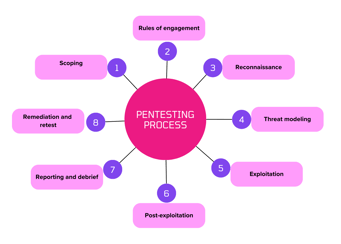
Good penetration testing follows a clear, repeatable process, even if the tools and targets change. A set process keeps testing safe, predictable, and in line with your business’s risks.
1. Scoping
Defines objectives, in-scope and out-of-scope systems, critical assets, success criteria, and constraints such as time windows or environments. This requires involving engineering, operations, and legal/compliance early. So that the test reflects how your systems really work and if they respect contractual obligations.
2. Rules of engagement
These rules specify allowed techniques, testing windows, communication channels, escalation paths, and stop conditions. Answer these questions:
- Whether testing will be in the production or staging environment.
- How will sensitive data be handled?
- Which third parties need to be notified before the activity begins?
3. Reconnaissance
Testers gather information about your environment: external reconnaissance, such as DNS records and exposed services, and internal context, such as architecture diagrams or limited credentials for gray-box and white-box tests. The aim is to mirror what a capable attacker could realistically learn and use against.
4. Threat modeling
Using what they have learned, testers map attacker goals to plausible paths through your architecture: initial access, privilege escalation, lateral movement, and data exfiltration. This step keeps the test focused on realistic, high-impact scenarios rather than on random exploit attempts.
5. Exploitation
Testers safely exercise selected vulnerabilities to progress along realistic attack paths using techniques appropriate to the environment.
Not all vulnerabilities require full exploitation. In many cases, impact can be demonstrated through controlled techniques (e.g., partial exploitation, data access validation, or logical proof) without risking system stability.
6. Post-exploitation
Here, testers demonstrate business impact, such as accessing sensitive data or modifying critical configurations, while minimizing disruption.
This phase may include demonstrating lateral movement, privilege escalation, and limited persistence, ensuring actions remain controlled and do not affect system availability.
Testers collect evidence such as logs and screenshots to support remediation and executive communication.
7. Reporting and debrief
Critical findings should be shared right away, not just in a final report weeks later. At the end, you should get a clear report and debrief sessions for both executives and engineers. Also, there should be ample time to ask questions and clear up any confusion.
In 2026, reports are no longer static PDFs but "Live Remediation Dashboards" that integrate directly into Jira or GitHub issues.
8. Remediation and retest
Good providers and internal teams help you prioritize fixes, provide remediation advice, and retest high-risk issues. Without this cycle, penetration testing is just a snapshot, not a way to reduce risk over time. Read more here: The 2026 Remediation Playbook CISOs Have Been Waiting For (Free Download).
Pentesting Report
A good penetration testing report is not just a list of vulnerabilities, it is a decision-making tool. It helps leadership understand business risk and gives engineering teams a clear, prioritized action plan. This section walks through what a real pentest report contains and what each part tells you.
Executive Summary
The executive summary gives leadership a high-level view of risk without requiring them to read the full technical report.
It should clearly answer: What can go wrong? How bad could it be for the business? What should we do next?
The core of this section is the vulnerability count table - a breakdown of findings by severity level across each asset tested. In the Siemba report, one asset (the Web Application, classified as Business Critical) was tested, yielding the following:
|
Hostname |
Critical |
High |
Medium |
Low |
Info |
|
Web app |
0 |
0 |
0 |
0 |
1 |
Spread of Vulnerabilities
The severity breakdown is visualized in the report as a donut chart, giving readers an immediate picture of the vulnerability spread. In this engagement, all findings were Informational, meaning no directly exploitable vulnerabilities were identified during the test window.
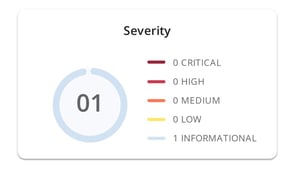
Fig 1 — Severity spread from the Siemba PT22 report: 0 Critical, 0 High, 0 Medium, 0 Low, 1 Informational.
When reviewing this chart in any report, look beyond the total count. A single Critical finding carries far more weight than ten Low findings. Severity distribution, not total volume determines remediation priority.
Threat Posture & Risk Accepted
The Threat Posture Statistics section gives the overall asset risk score, a composite number calculated as:
Asset Risk Score = Vulnerability Criticality × Threat Probability × Asset Criticality
This score reflects not just how severe the vulnerabilities are, but how likely they are to be exploited and how critical the underlying asset is to business operations. The result maps to a five-tier scale:
|
Risk Level |
Score |
|
Critical |
9–10 |
|
High |
7–8 |
|
Moderate |
5–6 |
|
Low |
3–4 |
|
Minimal |
1–2 |
In the Siemba report, the overall threat posture was rated Minimal, with a score of 2 out of 10, as shown in the risk gauge below:
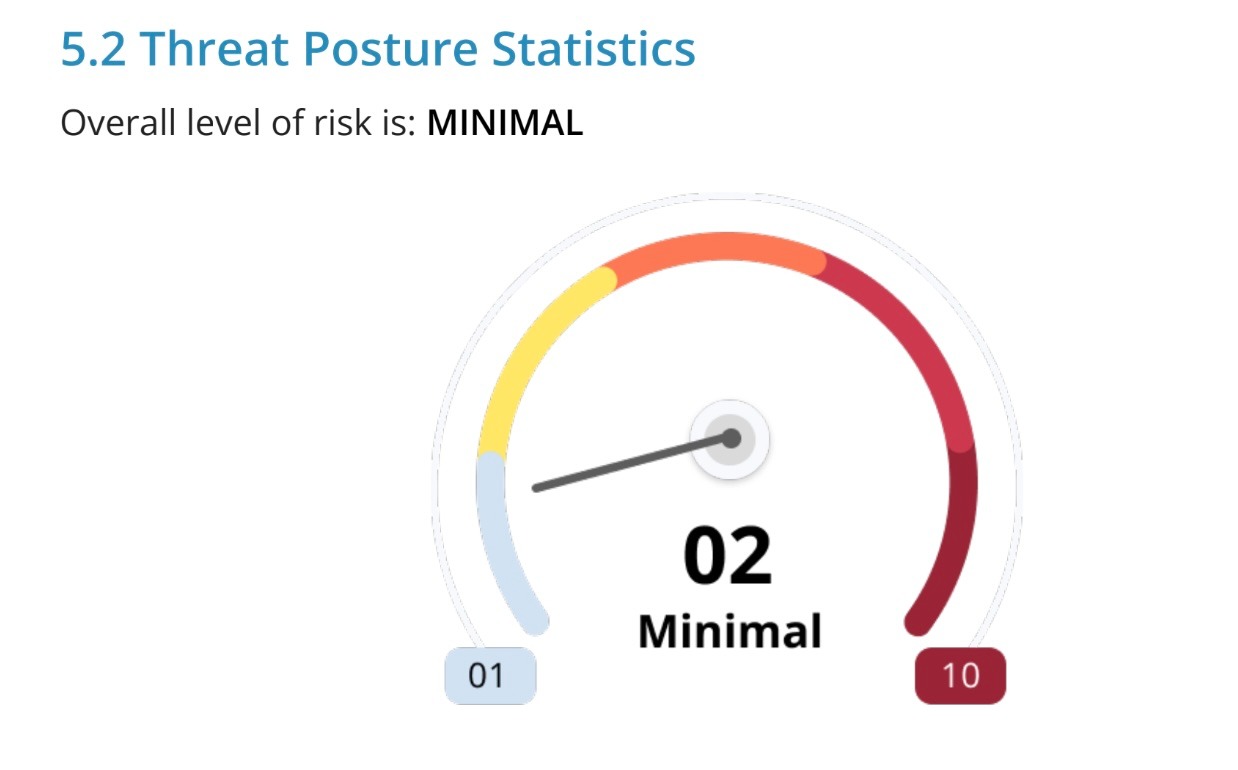
Fig 2 — Threat posture gauge from the Siemba PT22 report. Score of 02 = Minimal risk. The scale runs from 01 (lowest) to 10 (highest/critical).
The term Risk Accepted appears when an organisation acknowledges a finding but consciously decides not to remediate it; typically because the cost of the fix outweighs the likelihood or impact of exploitation. In the Siemba report, the single finding remains with a status of Open and a likelihood of Likely, meaning it has been identified but not yet closed or formally accepted. Any finding left open should have a documented justification in the Status Justification field.
What to watch for
Risk accepted findings should not pile up silently. Each open or accepted-risk item should carry a documented owner, a review date, and a clear rationale. An accumulation of accepted risks without review is a governance red flag.
Detailed Findings
The findings section is the technical core of the report. Each entry in the findings table shows the finding name, risk level, retest status, scoring details, and likelihood. This table is the first thing a developer or security engineer looks at when prioritizing fixes.
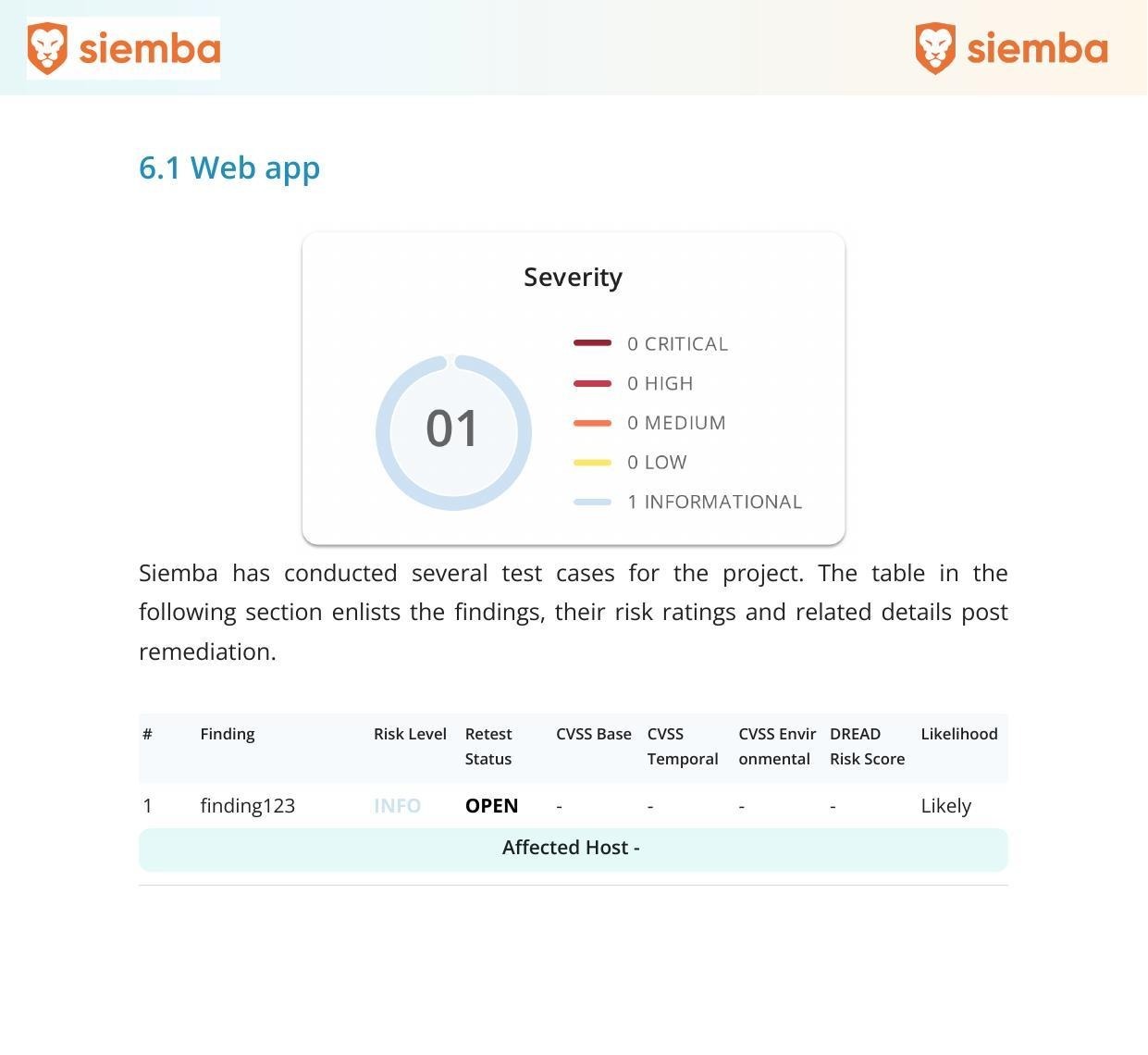 Each finding in the table links to a full detail entry containing:
- Severity & Status: risk tier and whether it is Open, Closed, or Risk Accepted
- Likelihood: how probable exploitation is in this specific environment
- CVSS / DREAD Score: standardised numeric risk scores
- OWASP / CWE Category: classification for tracking and benchmarking
- Vulnerable Endpoint: the exact URL or parameter affected
- Finding Description & Impact: what it is and what happens if exploited
- Proof of Concept & Steps to Reproduce: evidence proving exploitability
- Remediation Recommendation: specific, actionable fix guidance
Key insight
Strong pentest reports show how attackers actually chain vulnerabilities — not just list them in isolation. A weak password policy combined with an exposed admin panel becomes a full system takeover. A misconfigured API combined with missing authorization checks becomes cross-user data access. The finding detail section is where those chains should be documented.
5. Risk Scoring Models
Reports use two standardised scoring frameworks to rate findings consistently.
DREAD
Rates five dimensions - Damage Potential, Reproducibility, Exploitability, Affected Users, and Discoverability producing a score that maps to a severity tier from Low (1.0–3.9) up to Critical (9.0–10.0).
Scores are adaptive: the same vulnerability scores differently depending on how critical the affected asset is.
CVSS
Calculated from vectors including Attack Vector, Attack Complexity, Privileges Required, User Interaction, Scope, and impact across Confidentiality, Integrity, and Availability. The Siemba report references the CVSS 4.0 calculator at first.org for score generation.
Common mistake
Don't treat every high CVSS score as high business risk. A critical CVE on a system with no exploit path, no external exposure, and no sensitive data may be lower priority than a medium-severity broken authentication issue sitting on your payment system. Always evaluate severity in the context of your environment.
Penetration Testing vs. Vulnerability Assessment
This table answers the few fundamental questions related to pentesting and vulnerability assessment across detection depth, exploitability, attack paths, and remediation outcomes.
|
Aspect |
Vulnerability Assessment (VA) |
Penetration Testing |
|
Approach |
Automated scanning using signature, configuration, and pattern-based detection |
Adversary-simulated testing combining expert-led techniques with tool-assisted analysis |
|
Output Quality |
Large volume of detected vulnerabilities, including potential false positives and unvalidated findings |
Validated, reproducible vulnerabilities with confirmed exploitability and contextual risk |
|
False Positives |
Higher likelihood; requires manual triage and validation |
Significantly reduced through manual verification and controlled exploitation |
|
Depth of Analysis |
Surface-level identification of known vulnerabilities and misconfigurations |
Deep analysis including exploit validation, attack chaining, and contextual weaknesses |
|
Proof of Impact (Exploitability) |
Typically theoretical; no proof of exploitation |
Includes proof of concept (PoC) demonstrating real-world impact |
|
Attack Paths |
Not identified; findings are isolated |
Clearly maps attack paths from initial access to privilege escalation and impact |
|
Remediation Guidance |
Generic recommendations based on known fixes |
Remediation guidance aligned to root cause and exploit path |
|
Use Case |
Continuous monitoring, asset hygiene, and baseline security visibility |
Risk validation, attack simulation, and security control effectiveness testing |
|
Example |
50 high-severity vulnerabilities identified across systems, without clarity on exploitability or priority |
Weak authentication combined with exposed admin access leads to full account takeover demonstrating a clear attack path and business impact |
In practice, vulnerability assessments generate large volumes of signal mixed with noise lists of potential issues that still require validation and prioritization.
Penetration testing, in contrast, delivers a focused set of validated, exploitable findings with clear attack paths, proven impact through proof of concept, and actionable remediation guidance.
PTaaS vs. Traditional Penetration Testing
Rapid changes across cloud, APIs, identities, and AI systems have made periodic penetration testing insufficient. Fixed testing cycles often miss short-lived exposure windows where real risk exists.
To address this, organizations are adopting Continuous Offensive Security Testing (COST), a model emphasized by Gartner as part of modern security validation.
COST combines penetration testing with automated and autonomous testing to continuously validate exploitable risk. By integrating automation, AI-driven analysis, and human adversarial expertise, it enables ongoing identification and validation of real attack paths as systems change.
PTaaS platforms operationalize continuous testing practices and often serve as an execution layer within broader Continuous Offensive Security Testing (COST) programs.
Let us review this table to understand how PTaaS (Penetration Testing as a Service) differs from traditional penetration testing.
|
Feature |
Traditional Pen Testing |
PTaaS |
|
Testing Model |
Periodic, time-bound assessments (annual/quarterly) |
Initiated by environmental changes (e.g., deployments, configuration drift, asset exposure), enabling change-driven, on-demand validation aligned with continuous security programs (e.g., COST). |
|
When Testing Happens |
Pre-scheduled engagements |
Triggered by deployments, exposure changes, identity updates, or emerging threats |
|
Speed |
Weeks for scoping, scheduling, and execution |
Faster initiation with iterative testing cycles |
|
Scope |
Fixed scope defined upfront |
Dynamic, risk-based scope that evolves with asset and environment changes |
|
Coverage Gaps |
Exposure windows between test cycles |
Reduced gaps through continuous or repeated validation |
|
Attack Surface Coverage |
Limited to in-scope assets at a point in time |
Expands with continuous asset discovery (cloud, APIs, identities, hybrid environments) |
|
Testing Methods |
Primarily manual penetration testing |
Combines expert-led testing with automation for discovery, validation, and retesting |
|
Prioritization |
Based on predefined scope and severity ratings |
Based on exploitability and business impact |
|
Automation & AI |
Limited automation; manual-heavy workflows |
Uses automation and AI to support asset discovery, triage, and continuous validation |
|
Metrics |
Activity-based (tests conducted, findings reported) |
Outcome-based (risk reduction, exposure window, time-to-validate/remediate) |
|
Reporting |
Static report delivered at the end of engagement |
Continuous visibility with updated findings, validation status, and remediation tracking |
Benefits of Penetration Testing
Penetration testing goes beyond identifying vulnerabilities, it helps organizations understand real-world risk and improve overall security posture.
Identifies Exploitable Weaknesses
Penetration testing doesn’t just list vulnerabilities, it validates whether they can actually be exploited, helping teams focus on what truly matters.
Reduces Real-World Risk
It uncovers security gaps across systems, networks, applications, and configurations that could lead to breaches, ransomware, or service disruption.
Improves Security Readiness
Penetration testing reveals gaps not only in technology, but also in detection and response. For example, it may highlight missed alerts or ineffective monitoring during simulated attacks.
Supports Compliance Requirements
Many standards and regulations such as PCI-DSS, ISO 27001, SOC 2, and HIPAA require penetration testing. Regular testing helps meet these requirements while strengthening trust with customers and stakeholders.
Builds Confidence in Defenses
By testing real attack scenarios, penetration testing validates whether controls like authentication, access management, and monitoring systems work as expected.
Penetration Tester: Skills and Responsibilities
Here are the key skills a penetration tester needs.
- Ethical Boundaries: Penetration testers need to work within the approved scope and authorization limits. They should follow ethical guidelines to make sure testing does not harm systems, users, or data.
- Safe and Controlled Exploitation: Vulnerabilities should be exploited carefully and in a controlled manner, without damaging systems.
- Documentation: Penetration testers need to record all findings clearly, using evidence like screenshots, logs, and lists of affected systems. Reports should explain how vulnerabilities were found and exploited. They should also include risk ratings and offer practical advice for fixing them.
- Responsibility while Disclosure: Testers should avoid public disclosure until issues are fixed. They need to follow coordinated disclosure processes when third-party systems are involved.
- Collaboration: Testers should explain vulnerabilities, suggest secure coding and configuration changes, and help with retesting after fixes to make sure issues are resolved, and security stays strong.
The business impact is significant. IBM reports that the average cost of a data breach has reached $4.45 million globally, reinforcing the need to identify and remediate exploitable risks faster.
How Penetration Testing is Evolving in 2026
Penetration testing is no longer a periodic, standalone activity. In 2026, it is evolving into a continuous, integrated capability aligned with how modern systems are built and changed.
Organizations are moving beyond annual or quarterly assessments toward models that validate risk as environments evolve. This shift started with PTaaS (Penetration Testing as a Service), which introduced more flexible and repeatable testing. It is now expanding into broader, programmatic approaches like Continuous Offensive Security Testing (COST) where security validation becomes ongoing, adaptive, and closely tied to real-world changes.
This evolution is also driven by deeper integration with engineering workflows, better visibility into the attack surface, and the use of AI to improve efficiency.
Continuous Testing with COST
Continuous Offensive Security Testing (COST) represents a shift from time-based testing to change-driven validation. Instead of waiting for scheduled assessments, testing is initiated based on events such as deployments, configuration changes, or newly exposed assets.
COST combines penetration testing with automated and autonomous validation techniques, enabling continuous assessment of exploitable risk while reducing exposure windows.
Integration with DevSecOps
Penetration testing is increasingly embedded into development workflows. High-risk components are tested during releases, and findings are fed back into engineering pipelines helping teams fix root causes rather than treating issues as one-off vulnerabilities.
Attack Surface Management (ASM)
Modern environments are dynamic, with assets constantly being created, modified, or exposed. ASM helps continuously discover internet-facing assets, shadow IT, and misconfigurations, ensuring testing scope reflects the actual attack surface, not a static inventory.
AI Augmentation
AI is improving the efficiency of penetration testing by accelerating reconnaissance, prioritizing findings, and suggesting potential attack paths. This allows human testers to focus on complex areas such as business logic flaws, authorization issues, and multi-step attack chains.
PTaaS Platforms
PTaaS platforms enable scalable, repeatable penetration testing with faster turnaround and continuous visibility. They act as an execution layer within broader continuous testing models, supporting ongoing validation rather than one-time assessments.
The Role of AI and Human Expertise
AI is becoming a key enabler in penetration testing, but it does not replace human expertise. Automated systems are effective at scale and pattern detection, but often miss context-specific and logic-driven vulnerabilities.
Effective security programs combine automation with human adversarial thinking to ensure findings are accurate, reproducible, and aligned with real-world risk.
Penetration Testing Tools: Types
Here are the main categories of pentesting tools based on the testing lifecycle.
- Information Gathering: They are used to collect basic information about the target system or network. They help identify domains, IP addresses, open ports, and network architecture. And assist testers in understanding the attack surface before testing begins.
- Vulnerability Scanning: They can automatically scan systems, networks, and applications for known vulnerabilities. They detect issues such as missing patches, outdated software, and insecure configurations. They can generate reports with severity ratings to help prioritize remediation.
- Exploitation-based: These pentesting tools allow the testers to safely exploit identified vulnerabilities. They demonstrate how attackers could gain access, escalate privileges, or execute code.
- Password Testing: These tools are used to check the strength of authentication systems and password policies. They can perform techniques such as brute force, dictionary attacks, or credential testing. They help identify weak passwords or poorly configured authentication mechanisms, so that these vulnerabilities can be fixed.
- Web Application Testing: They detect issues such as injection attacks, broken authentication, and misconfigurations. They help testers analyze requests, responses, and application behavior. Read more: Web Application Penetration Testing Checklist: A Complete Guide.
- Network Analysis: Used to monitor and analyze network traffic during testing. They help identify insecure communications, data leaks, or unusual network behavior.
- Reporting and Documentation: Using these, testers organize findings and generate professional reports that include vulnerability descriptions, evidence, and remediation steps.
Learn more here about the top tools: Best Penetration Testing Tools For Modern Security Teams (2026).
How to Get Started with Penetration Testing?
These steps will help you start penetration testing in your organization.
Step 1: Scope
- Define the objective of the penetration test.
- Identify systems, applications, and networks to be tested.
- Decide if the test is internal, external, or both.
- Specify testing types (network, web application, API, etc.).
- Define test boundaries and assets that must not be disrupted.
- Set testing windows to avoid operational impact.
- Document in-scope and out-of-scope IPs, domains, and applications.
- Choose the test approach (black-box, white-box, or gray-box).
- Establish rules of engagement, approvals, and authorization.
- Define reporting expectations and deliverables.
Step 2: Prepare Internally
- Notify IT and security teams about the testing schedule.
- Assign internal contacts for coordination.
- Make sure system backups are available.
- Review architecture diagrams and system documentation.
- Provide credentials if white-box testing is required.
- Confirm monitoring systems and logging are active.
- Prepare incident response teams for alerts.
- Identify critical systems needing careful handling.
- Verify environment stability and firewall configurations.
- Review patch levels, access permissions, and update records.
- Prepare vulnerability management and remediation plans.
Step 3: Mistakes to Avoid
- Starting testing without authorization or communication.
- Poorly defined scope or ignoring critical assets.
- Not creating system backups before testing.
- Ignoring false positives from scanning tools.
- Underestimating testing time.
- Lack of documentation during testing.
- Failing to prioritize and validate vulnerabilities.
- Ignoring security monitoring and alerts.
- Misinterpreting vulnerability severity levels.
- Not retesting after fixes are applied.
- Producing unclear reports or failing to track remediation progress.
How to Build a Continuous Security Program with Siemba
Traditional penetration testing is helpful. However, in today’s AI-driven threat landscape (which has its own issues), a single report is not enough. Organizations need to move from reacting to threats to managing them before problems happen.
In 2026, penetration testing is an ongoing process rather than a one-time exercise. Siemba provides an AI-powered Full-Stack Continuous Threat Exposure Management (CTEM) platform that brings the entire offensive security lifecycle into a single system.
For continuous testing, Siemba provides:
- EASM (External Attack Surface Management): Continuous discovery of your internet-exposed assets to eliminate blind spots.
- GenVA (AI-Driven Vulnerability Assessments): High-fidelity AI scanning that filters the signal from the noise.
- GenPT (AI-Driven DAST): Autonomous, payload-driven testing that goes beyond surface scans.
- PTaaS (Enterprise PenTest as a Service): Scalable, expert-led penetration testing that you can schedule once and repeat automatically.
- AISO (AI Security Officer): Your AI partner that translates technical vulnerabilities into business risk, maximizing your Return on Mitigation (RoM).
Security should be adopted as a culture of ongoing protection. Sign up for a CTEM Platform Demo to strengthen your security program today.
Security should be adopted as a culture of ongoing protection. Sign up for a CTEM Platform Demo to strengthen your security program today.
Success Stories From Our Clients
.png?width=380&height=378&name=image%20(58).png)
Alex Chriss
Company, Designation
“Unify security capabilities, amplify impact, and strengthen resilience. Here’s why leading organizations trust Siemba to proactively defend against evolving threats.”
Alex
Marko, Ceo
“Unify security capabilities, amplify impact, and strengthen resilience. Here’s why leading organizations trust Siemba to proactively defend against evolving threats.”
John
Company, Designation
“Unify security capabilities, amplify impact, and strengthen resilience. Here’s why leading organizations trust Siemba to proactively defend against evolving threats.”
Juliya
Company, Designation
“Unify security capabilities, amplify impact, and strengthen resilience. Here’s why leading organizations trust Siemba to proactively defend against evolving threats.”
Huno
Company, Designation
“Unify security capabilities, amplify impact, and strengthen resilience. Here’s why leading organizations trust Siemba to proactively defend against evolving threats.”
Success Stories
-
 How often should we run penetration testing on critical systems?
 Many organizations test crown-jewel systems at least annually, with additional tests after major changes or new launches. Internet-facing and revenue-critical applications often justify a quarterly or continuous model, while lower-risk systems can follow a lighter cadence. There is no single correct answer for how often to do penetration testing. For most organizations, a risk-based baseline works well.
-
Does penetration testing replace vulnerability scanning or bug bounty programs?
No. Vulnerability scanning provides ongoing hygiene and coverage; penetration testing validates real attack paths in depth; bug bounty adds creative, crowd-sourced testing. Mature programs use all three, with clear scopes and expectations for each. And while there is some overlap, each of these approaches is a distinct activity, with its specific purposes and coverage area.
-
What environments should we test: production, staging, or both?
Staging is safer for disruptive tests, but only production reflects real configurations, data, and integrations. Many teams test primarily in staging, with tightly controlled production checks for exposure and critical paths, defined in the rules of engagement.
-
What are exploits in pentesting?
Exploits in penetration testing are used to demonstrate how vulnerabilities can be used to compromise systems, showing the real impact of security weaknesses. An exploit is a technique or code that triggers a vulnerability to gain unauthorized access, execute commands, or access sensitive data. Testers use exploits safely and in a controlled way to prove risks are real and help organizations prioritize remediation.
-
Can we safely use AI-assisted tools for internal penetration testing?
AI can speed up reconnaissance and triage, but it still needs human oversight for scoping decisions, exploit use, and interpreting business impact. A key consideration here is deterministic vs. non-deterministic testing. The traditional tools produce consistent, repeatable results, while AI-driven approaches can be non-deterministic, meaning outputs may vary between runs.
Because of this variability, AI should be treated as an assistant to qualified testers, not a one-click replacement. This is needed to keep the findings validated, reproducible, and aligned with real-world risk.
-
Who performs pentesting?
Penetration testing can be performed by in-house security teams, external cybersecurity consultants, or managed penetration testing providers that deliver ongoing testing services. Organizations may also use automated or AI-driven platforms to scan systems, simulate attacks, and quickly identify vulnerabilities.
The best approach depends on the organization’s risk profile, expertise, and available resources.