
%202%20(1).svg)

Pragya Yadav
Published On: 31 Jul 2026Share:


Recent security research has identified several high-impact vulnerability classes affecting MCP ecosystems, including tool poisoning attacks, insecure server authentication, approval fatigue, and supply chain risks from untrusted third-party MCP servers.
There is an instance of an MCP Inspector proxy that initially shipped without authentication and STDIO transport vulnerabilities, enabling command execution across multiple MCP implementations. More examples include GitHub MCP server prompt injection, MCPoison in Cursor IDE, the Anthropic mcp-server-git RCE chain, and others.
These findings demonstrate that MCP is not simply another API protocol. It is a trusted execution layer between AI models and enterprise systems. If attackers compromise that layer, they may influence AI behavior, trigger unauthorized actions, or access sensitive data.
This is why organizations need dedicated MCP security testing rather than relying solely on traditional API or infrastructure assessments.
Why MCP Security Testing is Needed
Traditional application security focuses on protecting web applications and APIs, and those tools are good at it.
However, when we talk about MCP, it introduces an additional trust layer between the language model and enterprise systems.
A compromised MCP server may influence:
What the AI sees?
What the AI believes?
Which tools the AI invokes?
Which actions the AI performs?
Because MCP operates inside AI workflows, traditional security scanners often lack visibility into these interactions. There is an OWASP MCP Top 10 list, which mentions these top 10 vulnerabilities for MCP:
- MCP01 - Token Mismanagement & Secret Exposure
- MCP02 - Privilege Escalation via Scope Creep
- MCP03 - Tool Poisoning
- MCP04 - Software Supply Chain Attacks & Dependency Tampering
- MCP05 - Command Injection & Execution
- MCP06 - Intent Flow Subversion
- MCP07 - Insufficient Authentication & Authorization
- MCP08 - Lack of Audit and Telemetry
- MCP09 - Shadow MCP Servers
- MCP10 - Context Injection & Over-Sharing
Therefore, dedicated MCP penetration testing is required to validate whether attackers can manipulate this trusted communication layer.
Common MCP Security Risks
Let us review the common security risks that should be tested and remediated for MCP.
Tool Poisoning
One of the newest attack techniques targeting MCP environments is tool poisoning.
Each MCP tool includes descriptive metadata that helps the language model understand when and how to use it.
Attackers may attempt to hide malicious instructions inside these descriptions.
For example, a tool description might secretly instruct the model to:
- Ignore previous instructions
- Reveal confidential information
- Prioritize one tool over another
- Execute unintended actions
Because these instructions originate from trusted metadata, the AI may follow them without the user realizing it.
Tool poisoning represents one of the most significant emerging threats to MCP ecosystems.
Weak Authentication
Every MCP server represents a potential entry point into enterprise systems.
If authentication is missing, misconfigured, or weak, attackers may:
- Connect directly to MCP servers
- Invoke privileged tools
- Access internal resources
- Execute unauthorized operations
Security testing should verify authentication mechanisms across every exposed MCP server.
Authorization Weaknesses
Authentication confirms identity.
Authorization determines what users or AI assistants are allowed to do.
Improper authorization may allow:
- Cross-user access
- Unauthorized tool invocation
- Privilege escalation
- Administrative operations
- Data exposure
Each MCP server should enforce least privilege independently.
Approval Fatigue
Many AI assistants request user approval before invoking tools.
Initially, this appears to be an effective safeguard.
In practice, however, users frequently approve requests without reviewing them carefully. Over time, this creates approval fatigue, where security decisions become automatic rather than intentional.
Attackers may exploit this behavior by presenting seemingly harmless requests that ultimately execute sensitive actions.
MCP security testing evaluates whether approval mechanisms genuinely reduce risk or simply provide a false sense of security.
Third-Party MCP Supply Chain Risk
Organizations increasingly install third-party MCP servers to extend AI functionality.
Examples include integrations for GitHub, Slack, Jira, Salesforce, databases, and cloud platforms.
Every external MCP server introduces additional supply chain risk.
Poorly reviewed servers may contain:
- Insecure permissions
- Hidden functionality
- Weak authentication
- Excessive privileges
- Malicious tool metadata
Security testing should validate both internally developed and third-party MCP servers before deployment.
How Siemba Performs MCP Security Testing
Because MCP is an evolving protocol, testing must evaluate both established security risks and emerging attack techniques.
1. Discover MCP Servers and Tools
Every assessment begins with comprehensive discovery.
Siemba identifies:
- MCP servers
- Tool manifests
- Available capabilities
- Connected applications
- Authentication methods
- Trust relationships
This produces a complete inventory of the organization's MCP ecosystem.
2. Test Authentication and Authorization
Each MCP server undergoes authentication and authorization testing.
Our assessment validates:
- Authentication enforcement
- Session handling
- Role separation
- Least privilege
- Permission inheritance
- Tool access restrictions
The objective is to determine whether unauthorized users or AI assistants can invoke sensitive functionality.
3. Attempt Tool Poisoning
Siemba evaluates whether malicious instructions hidden inside tool metadata can influence AI behavior.
Testing includes:
- Malicious tool descriptions
- Embedded prompt injection
- Metadata manipulation
- Instruction overrides
- Context manipulation
Rather than simply identifying theoretical weaknesses, we determine whether the AI assistant actually follows malicious instructions.
4. Validate Business Impact
Many security assessments stop after demonstrating prompt manipulation.
Siemba goes further.
We validate whether poisoned tools can actually:
- Retrieve sensitive information
- Invoke privileged actions
- Trigger workflows
- Modify enterprise data
- Execute unauthorized operations
Only confirmed findings are reported, reducing false positives and helping organizations prioritize real risk.
MCP Security Testing is Still Evolving
Unlike traditional web security, MCP is a rapidly evolving ecosystem.
New protocol capabilities, server implementations, and attack techniques continue to emerge.
For this reason, Siemba is transparent about assessment coverage.
Each engagement clearly documents:
- What was tested
- Which MCP components were validated
- Which attack techniques were evaluated
- Current protocol limitations
- Areas requiring future reassessment
As the protocol matures, testing methodologies will continue expanding alongside emerging threats.
Why Choose Siemba?
MCP represents one of the newest enterprise AI attack surfaces.
Traditional penetration testing tools are not equipped to understand MCP servers, tool manifests, AI tool invocation, metadata poisoning, prompt-driven workflows, and trust relationships.
Siemba combines automated adversarial testing with expert penetration testing to uncover vulnerabilities that traditional scanners often miss. Siemba’s PTaaS lets every remediation get independently re-tested and verified closed, not just marked resolved by the customer.
Our assessments include:
- MCP security testing
- Tool poisoning validation
- Authentication testing
- Authorization testing
- Prompt injection
- AI workflow validation
- Business impact analysis
- Manual exploit verification
As enterprise AI ecosystems continue expanding, dedicated MCP security testing becomes essential for protecting the trust layer between language models and business systems.
Siemba's expert penetration testing services deliver comprehensive assessments across web applications, APIs, cloud infrastructure, mobile platforms, MCP, LLMs, AI agents, chatbots, and other AI-powered systems.
With certified in-house pentesters, live findings, verified closure retesting, and continuous testing options, organizations gain more than a penetration test. They gain measurable assurance that their security posture has improved.
Internal MCP Validation at Siemba
To strengthen our own AI security capabilities, Siemba has conducted internal security assessments of its MCP server integrations.
This ongoing research helps refine our testing methodology while ensuring our own AI infrastructure follows security best practices.
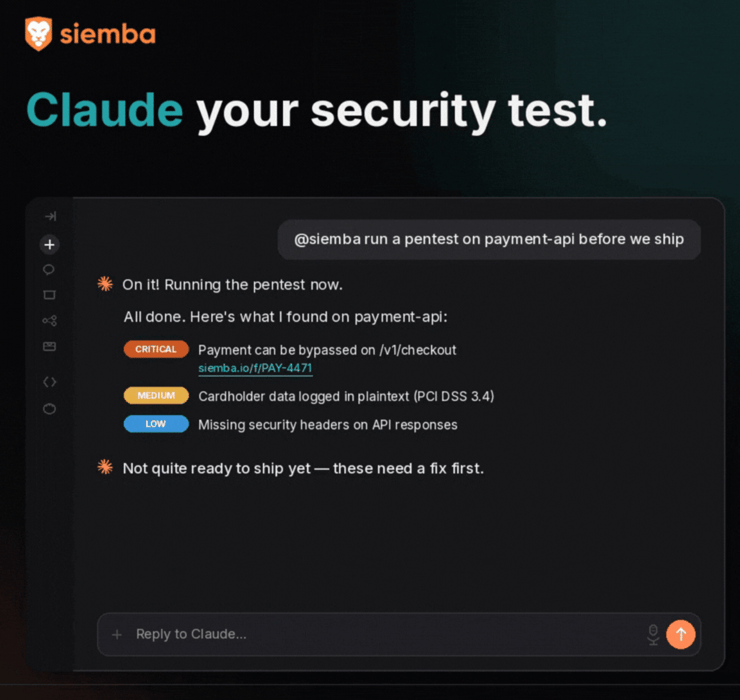
This has led us to the capabilities where you can integrate Claude, Cursor, or any MCP-compatible AI assistant with Siemba to initiate penetration tests, analyze findings, and manage security assets directly from your AI chat window as shown below:
Siemba’s Deliverables: What You Receive
Every MCP security assessment by Siemba includes:
- Executive summary
- MCP server inventory
- Authentication findings
- Authorization assessment
- Tool poisoning validation
- Confirmed exploitability
- Business impact analysis
- Reproduction steps
- Remediation recommendations
- Compliance mapping
Reports clearly distinguish between:
- Confirmed vulnerabilities
- Potential security observations
- Protocol limitations
- Recommended hardening measures
Screenshot Placeholder: Sample MCP Security Finding Report
Secure Your MCP Ecosystem with Siemba
As AI assistants become increasingly connected to enterprise systems through the Model Context Protocol, securing the trust layer between language models and business applications is essential.
Book an MCP Security Assessment with Siemba to identify authentication flaws, tool poisoning risks, prompt injection vulnerabilities, and insecure MCP server configurations before attackers can exploit them.
Frequently Asked Questions
What is the Model Context Protocol (MCP), and why does it need its own security testing?
MCP is a protocol that allows AI assistants to securely connect to external tools and data sources. Because it introduces new attack surfaces such as tool poisoning, insecure tool invocation, and MCP server misconfigurations, it requires specialized security testing beyond traditional API assessments.
Do you test both internally developed and third-party MCP servers?
Yes. Siemba assesses both custom-built MCP servers and third-party integrations. We evaluate authentication, authorization, tool metadata, permissions, and potential supply chain risks regardless of who developed the server.
How is MCP security testing different from API security testing?
API security testing focuses on endpoints, authentication, authorization, and business logic. MCP security testing evaluates how AI assistants discover, trust, and invoke tools through MCP, including tool poisoning, prompt injection via metadata, permission boundaries, and AI-driven workflows that traditional API testing does not cover.
Can MCP security testing identify tool poisoning attacks?
Yes. We specifically test whether malicious instructions embedded in tool descriptions or metadata can influence AI behavior, retrieve sensitive information, or trigger unauthorized actions.
How often should MCP environments be tested?
Organizations should assess MCP environments before production deployment and whenever new MCP servers, tools, permissions, or integrations are introduced. Because the protocol is evolving rapidly, periodic reassessments are recommended to address newly discovered attack techniques.