
%202%20(1).svg)

Vasudev Menon
Published On: 18 Feb 2026Share:


An hour-by-hour breakdown of how mature security teams respond and where most programs fail.
Why the First 24 Hours Matter
The first day after a security incident shows your security program’s true maturity far more than dashboards, audits, or reports. It’s not about appearances; it’s about how your team responds when systems break.
It shows how you measure security, how often you test your assumptions, and how closely your defenses connect to actual business risk.
It also makes clear whether your program is reactive or proactive, whether your incident response is truly effective, and how well continuous security validation and CTEM (Continuous Threat Exposure Management) inform decision-making under pressure.
The Reality of Security Program Maturity
Many programs look strong on paper:
- Passed audits
- Comprehensive tool coverage
- Long vulnerability lists
However the true test comes when an attacker exploits weaknesses in live systems. Real security comes from:
- Knowing which attack paths are exploitable
- Understanding how controls behave under real-world conditions
- Aligning response with actual business risk
Preemptive cybersecurity and continuous validation close this gap. They transform security from a set of point-in-time scores into a living defense system, continuously proving what is safe and what could become an incident tomorrow.
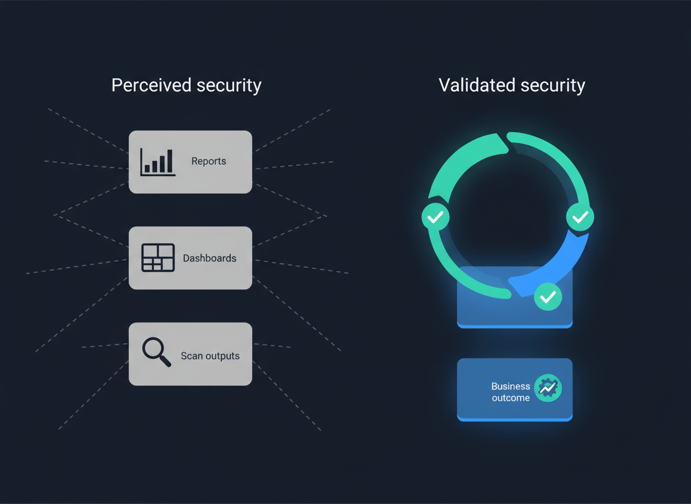
This article walks you through the next 24 hours, hour by hour, and shows how your approach might bring to light the inefficiencies and gaps in underlying systems, processes, and culture.
Anatomy of an Incident Response
Imagine a high-severity incident hits late on a weekday. A SOC alert fires, and within minutes, the on-call engineer, SecOps lead, CISO, and GRC team know something critical is happening.
From that moment, the timer starts.
It is a timer on technical containment. And it is also a timer on how you will brief executives, regulators, and customers, and on how well you can prove what actually happened.
Over the next day, three truths become clear.
- How quickly the team moves from raw alerts to real exposure
- How far they trust their own data and evidence
- And how closely their actions align with business impact, obligations, and risk appetite
We will look at 4 windows in that first day, from 0-2 hours through 12-24 hours, as a lens on both weaknesses and strengths in post-breach response and hybrid enterprise security.
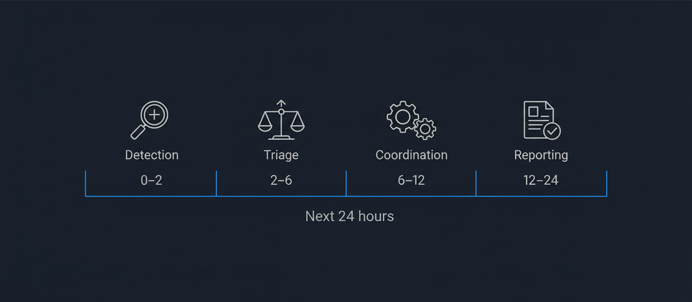
Hours 0-2: First Decisions
In the first two hours, what matters most is not how fast someone jumps into action, but how accurately the team understands what’s actually happening.
Good teams focus on confirming the signal and scoping the problem before anything.
Teams must answer a few critical questions:
How did we detect this activity and how confident are we in the signal?
Which assets, identities, and data might be involved?
Who needs to be in the room within the first 30 minutes?
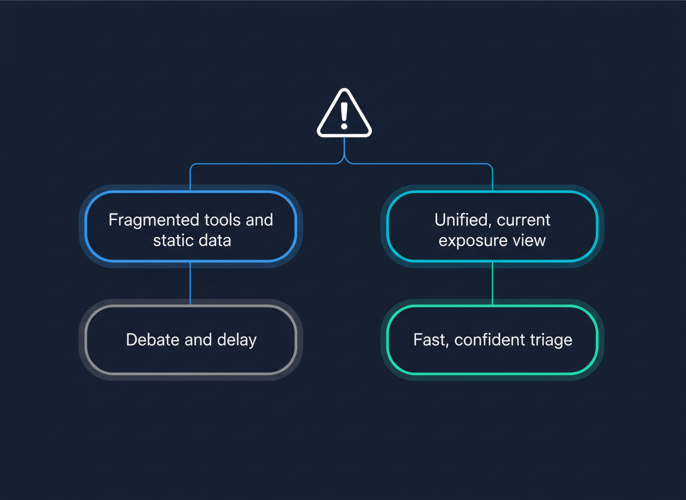
In tool-heavy, less mature programs, these hours are usually spent arguing over alerts and dashboards. One system says one thing, another says something else. Engineers jump between consoles trying to piece together context. Asset lists are outdated, diagrams don’t match reality, and containment stalls while people debate which data to trust instead of which exposure to close.
In immature, tool-centric programs, this window fills with confusion about which alert to trust and which system holds the source of truth. Teams spend time pulling context from multiple consoles. Static diagrams and outdated inventories become proxies for reality. Containment decisions drift while people argue about data instead of exposure.
In a preemptive posture, teams pivot quickly from detection to real-world exploitability. Current attack surface views show which systems and identities sit on likely attack paths. Clear playbooks define who joins the call, how severity is classified, and how to frame early business impact.
The first containment decisions are guided by risk and evidence, not just raw logs or instinct.
Hours 2-6: Shared Evidence
During hours 2-6, focus shifts from containment to creating a shared, evidence-based understanding of affected systems.
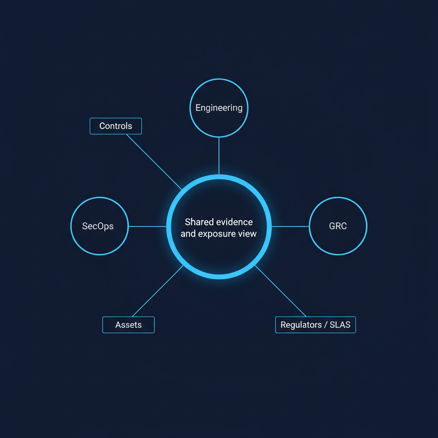
SecOps look at logs, telemetry and traces. Engineering maps which services and dependencies could be impacted.
GRC evaluates whether regulated data or contractual obligations may be involved. Internal updates begin, and early regulatory impact starts to take shape.
In organizations anchored in point-in-time testing, people reach for the last penetration test, audit report, or assurance letter to guess what might be exposed. Evidence lives in spreadsheets and email threads. SecOps, engineering, and GRC sometimes hold different pictures of what controls exist and how they behave in production.
In a preemptive cybersecurity model, teams pull near-real-time views of internet-facing assets and internal systems that intersect with the incident. Continuous validation shows which controls were recently exercised against similar attack patterns. GRC, SecOps, and engineering work from a shared evidence base and a common language for business risk alignment and audit-ready evidence.
Hours 6-12: Control Reality
Between hours six and twelve, teams face a tougher question: do your controls actually work the way you think they do in real environments? They check whether systems are properly isolated, whether identity controls behave as expected, whether segmentation holds, and whether logging and monitoring are doing what they’re supposed to do.
In checkbox-oriented programs, controls are validated mainly during scheduled audits or assessments. When a real incident happens, responders spend hours recreating tests by hand to see whether a policy holds for this specific scenario. It is difficult to say whether similar attack paths exist elsewhere or if this is an isolated one-off exposure.
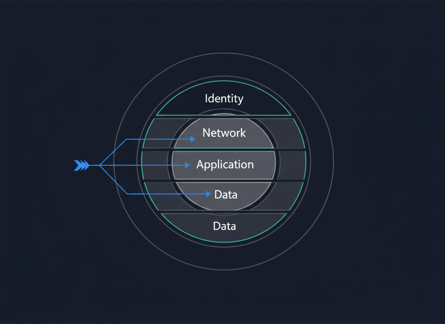
In a living defense system, continuous validation and adversarial testing have already mapped likely attack paths and control behavior across key environments. Teams can reference recent validation results for the same class of exposure rather than starting from scratch. Leadership sees control effectiveness as a set of layers, not single points, and can judge how identity, network, application, and data defenses respond together in practice.
Hours 12-24: Business Alignment
By the twelve-hour mark, the incident is no longer only technical. Leaders are preparing to brief executives, answer regulator or customer questions, and decide how visible the event should be outside the organization. The quality of communication now depends on how well earlier hours turned data into decision-ready insight.
In reactive, tool-driven programs, this is where things break down. Teams struggle to translate technical details into plain business impact. Different groups share slightly different timelines because they rely on different data sources. There's limited ability to see what changed, what was exposed, the coverage and how well controls actually worked.
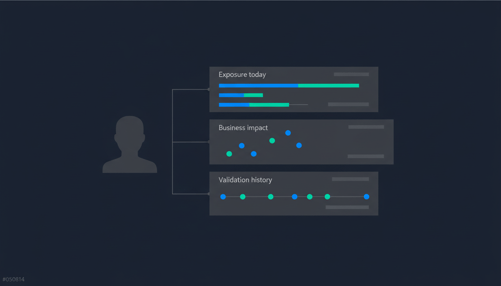
In mature programs, leadership already sees executive risk reporting anchored in business services, obligations, and agreed risk thresholds. Teams can present audit-ready evidence of prior continuous validation for this incident class. Communication and remediation decisions focus on high-impact attack paths and critical assets rather than the noisiest alerts. The program shows business risk alignment in practice, not only in policy documents.
Indicators of Reactive Security
- Surprise about which assets and identities are actually involved, despite documented inventories and diagrams.
- Dependence on last year's penetration test or audit report to guess current exposure and attack paths.
- Teams debating which tool's view is correct instead of which attack paths matter most to the business.
- Difficulty assembling a single coherent timeline, evidence set, and narrative from scattered logs and reports.
- Inability to express risk in clear business terms within the first day, even when technical details are available.
Together, these signals show a gap between security activity, point-in-time testing, and the validated, decision-ready insight that leaders need.
Characteristics of Mature Programs
- Fast, confident scoping of what's affected, based on a living map of the hybrid attack surface.
- Immediately linking suspected activity to known attack paths and previously validated controls or compensating measures.
- Shared evidence, terminology, and context across SecOps, engineering, and GRC, reducing friction during decisions.
- Executive-ready views that summarize exposure, potential impact, and remediation priorities without losing necessary technical depth.
- Continuous validation results that place this incident in the context of an ongoing CTEM program and living defense system.
Redesigning Your Next 24 Hours
The goal is not to perfect every response. It is to make the next 24 hours calmer, more predictable, and more aligned with business priorities. You can design for that outcome long before the next incident occurs.
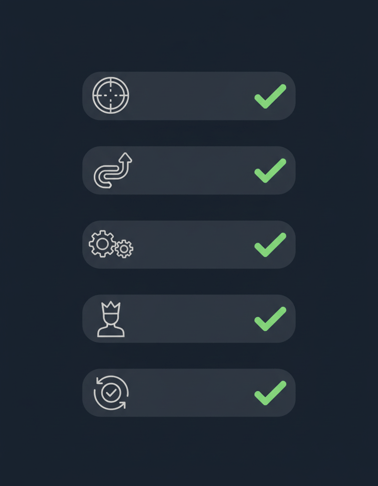
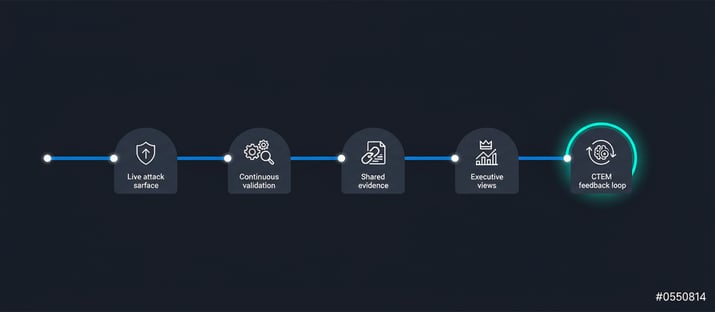
- Build a living map of your hybrid attack surface, updated continuously, and make it the default reference in any incident room.
- Integrate continuous validation of critical controls and attack paths into normal operations, not only scheduled assessments or crisis drills.
- Establish a shared evidence model that SecOps, engineering, GRC, and leadership trust and can access quickly during any event
.Design executive-ready views of exposure, business impact, and validation history in advance, so they are ready on day one of any incident. - Use incidents and near-misses to refine hypotheses and testing scenarios, and feed them back into your CTEM operating model.
When leaders treat CTEM as a decision-support discipline rather than a tool category, incident days start to feel like rehearsed drills instead of improvised theatre.
How Siemba Powers This Transition
You shouldn't have to build this "living defense" capability from scratch.
Siemba offers a Full-Stack Continuous Threat Exposure Management (CTEM) platform designed to replace point-in-time guessing with continuous, preemptive proof..
Unified Visibility (EASM): Continuously maps your external perimeter to discover shadow assets and unknown services, ensuring your team always has an up-to-date view of the attack surface.
Validated Proof (GenVA & GenPT + PTaaS): Goes beyond static severity scores by validating which vulnerabilities are actually exploitable using a combination of AI-driven attack simulation and continuous penetration testing as a service (PTaaS). This proves which controls work, which exposures are real, and filters out noise that causes decision paralysis.
Business Alignment (AISO): The AI Security Officer acts as a bridge, translating technical findings into business logic. This provides the "shared evidence" needed to align SecOps, GRC, and Executive leadership instantly, before the first hour of an incident ticks by.
Book a demo with our engineers to see your true exposure today and turn your security program into a validated, living defense.
Leading With Proof
The first 24 hours after a breach or serious incident reveal whether security is measured by promises and reports or by continuous, real-world proof. Each time window surfaces how detection works, how evidence is shared, how controls behave, and how clearly you communicate business impact.
Modern security leadership is the work of building living defense systems that can show, at any moment, where the organization stands and how it will respond. In an AI-driven landscape, credible leadership depends on preemptive cybersecurity, continuous validation, and clear alignment with business risk long before the next alert appears.