


Pragya Yadav
Published On: 16 Nov 2026Share:


In general, a penetration test may cost around $5,000 to $30,000 per engagement. Many organizations currently spend between $10,000 and $30,000 for pentesting. For small-scope tests, you may spend around $5,000, while large cloud, internal network, or red team engagements can surpass $100,000.
But why do these penetration testing quotes vary so much?
The answer is scope, complexity, testing depth, and the expertise required.
IBM Cost of a Data Breach Report 2026 mentions that the global average cost of a data breach is 4.99 million USD. Additionally, the report mentions that AI-driven attacks rose 56% compared with the previous year. Their financial impact was also significant, adding an average of $1 million per breach.
Recently, we witnessed many breaches and vulnerabilities, so much that the month was called Black October 2026.
This data highlights the need for having appropriate security testing in place if you want to avoid an exorbitant breach cost. So, the pentesting cost is not an expense; it is actually an investment to stay safe from any major vulnerability or breach.
In this guide, we break down typical penetration testing costs, explain what affects the pricing, and how to budget effectively without impacting security coverage.
Penetration Testing Cost by ‘Type’
The cost of a penetration test depends mainly on the systems being tested and also the depth of assessment. The following ranges can help with budgeting a one-off engagement.
|
Penetration test type |
Typical cost (USD) |
Depends on |
|
External network |
4,000-15,000+ |
Number of public-facing IPs, domains, exposed services, and network complexity |
|
Web application |
3,000-50,000+ |
Complexity of applications, integrations, pages, user roles, workflows, and application complexity |
|
API |
6,000-18,000 |
Number of endpoints, API types, authentication methods, and business logic complexity |
|
Mobile application |
8,000-30,000 |
Number of platforms (iOS/Android), app features, backend APIs, and authentication flows |
|
Internal network / Active Directory |
10,000-35,000 |
Number of hosts, network segments, domains, users, and Active Directory complexity |
|
PCI DSS penetration testing |
12,000-25,000 |
Number of in-scope systems, network segments, cardholder data environments, and compliance requirements |
|
Red team engagement |
25,000-100,000+ |
Scope of objectives, duration, attack scenarios, number of locations, and level of adversary simulation |
|
AI and LLM |
5000-20,000+ (AI/LLM pentest) 25,000-75,000 (multiple agents, proprietary models, or extensive expert-led AI red teaming ) |
Number of models and AI features, RAG pipelines, connected data sources, agent tools and integrations, user roles, and depth of adversarial testing for prompt injection, data leakage, and unsafe actions |
Note: These are indicative ranges only. The actual quote depends on the environment, number of assets, authentication requirements, and testing objectives.
For example, an external penetration test that covers a small set of public IP addresses may be quite straightforward. A web application with multiple user roles, single sign-on (SSO), payment workflows, and complex authorization rules will require more manual testing.
Specialist penetration testers in the US may charge approximately $150 to $400+ per hour, depending on their experience and the provider.
Penetration Testing Cost by ‘Company Size’
Company size can help you estimate a budget. But the number and complexity of assets matter more than employee count.
|
Company stage |
Indicative annual budget (USD) |
Scope |
|
Early-stage startup |
5,000-15,000+ |
Typically a single web and/or mobile app or small external network |
|
Growth-stage SaaS |
15,000-35,000+ |
Large or multiple web and/or mobile apps, external network, and API testing |
|
Mid-market |
30,000-75,000+ |
Multiple applications, APIs, cloud assets, and external networks |
|
Enterprise |
75,000-150,000+ |
Multiple applications, internal networks, cloud environments, AI apps, and red team exercises |
Note: These figures are just estimates. For example, a startup with a complex and business-critical platform may need more testing when compared to a larger company with a small attack surface.
You can start by identifying your most important applications, exposed services, sensitive data, and compliance requirements. Then scope the assessment around the risks that are most important.
Penetration Testing Cost by ‘Compliance’
According to the IBM Cost of a Data Breach Report 2026, healthcare is the costliest industry for breaches. Therefore, pentesting for compliance holds a top spot to avoid the cost associated with failing to adhere to compliance standards.
|
Framework |
Pentesting expectations |
Potential cost considerations |
|
SOC 2 |
For every audit period |
Application scope and audit evidence |
|
PCI DSS |
Requires penetration testing under applicable requirements |
Cardholder data environment and segmentation testing |
|
HIPAA |
Security risk analysis and risk management are required; pentesting can support security validation |
Scope, documentation, and evidence |
|
ISO 27001 |
Technical vulnerability management and risk-based security controls are relevant |
Testing scope and reporting needs |
For PCI DSS penetration testing, you may spend around $12,000-25,000 per year. It depends on the Cardholder Data Environment (CDE) and segmentation requirements. Other assessments vary based on the systems in scope.
Are You Using Vanta or Drata?
Platforms like Vanta and Drata help organizations manage compliance evidence, track security controls, and prepare for audits. However, they do not perform the work of an independent penetration test.
From a pentesting perspective, you still need qualified testers to actively test your applications, APIs, networks, and infrastructure for exploitable vulnerabilities.
If you're preparing for SOC 2, ISO 27001, HIPAA, or PCI DSS, choose a penetration-testing provider who can map findings to the relevant framework and deliver audit-ready reports. This makes it easier to upload evidence into Vanta or Drata. You can track remediation and demonstrate that identified risks have been addressed.
Cost consideration: Budget separately for the penetration test. Compliance automation subscriptions do not normally include a full independent pentest. The scope required by your auditor or framework can affect the overall cost.
What Affects Penetration Testing Cost?
The biggest factor that determines the pentesting cost is scope. As the number of systems and workflows increases for testing, the engagement requires more time. Thus, cost is impacted.
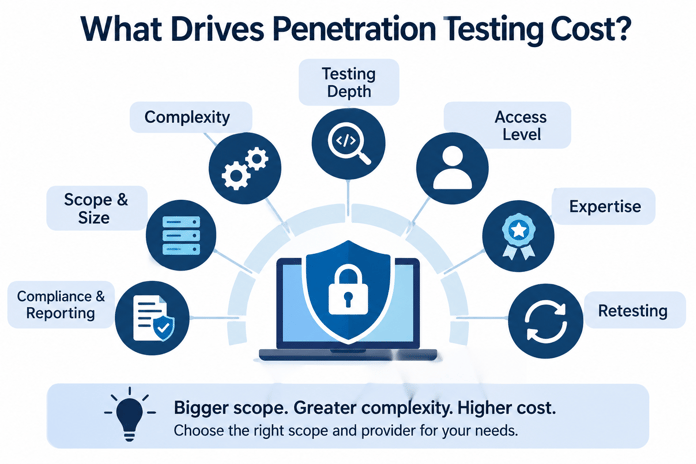
The following factors explain the pricing differences.
- Scope and size: The number of applications, API endpoints, IP addresses, cloud accounts, or network segments.
- Complexity: AI components, third-party integrations, data sensitivity, security, SSO, multi-tenancy, payment flows, user roles, and business-critical workflows require additional test cases.
- Testing depth: Automated tools can identify common issues, but manual testing is important for validating authorization flaws, business logic weaknesses, and chained attacks.
- Access level: Black-box testing starts with limited information; grey-box testing provides some credentials or documentation; white-box testing provides more extensive access. Grey-box testing can offer a practical balance between coverage and cost.
- Tester expertise: Experienced specialists may cost more, but their skills are valuable for complex vulnerabilities and attack paths.
- Compliance and reporting: Framework-specific evidence, formal reports, and audit requirements add effort.
- Retesting: Some providers include verification after remediation; others charge separately.
- Vendor reputation: Established security providers with expert testers, relevant certifications, recognized methodologies, strong client references, and a proven track record can provide greater confidence in the quality and credibility of the assessment,
When comparing quotes, ask vendors about the proposed scope, manual testing effort, deliverables, and retesting policy.
What are the Common Penetration Testing Pricing Models?
Providers typically use one of four pricing models.
|
Pricing model |
How it works |
Best suited for |
|
Fixed price |
One fee for a defined scope |
Clearly scoped engagements |
|
Hourly or daily rate |
Charges based on tester time |
Exploratory or changing scopes |
|
Per asset |
Charges per application, IP, or other asset |
Environments with many similar assets |
|
PTaaS subscription |
Combines platform capabilities with ongoing testing and, depending on the plan, expert engagements |
Teams needing recurring testing and year-round visibility |
Fixed pricing is a good option when the scope is clear. Hourly pricing is flexible but can make the final bill harder to guess. Per-asset pricing is straightforward, although it may not account for differences in complexity.
Penetration Testing as a Service (PTaaS) is useful if you need a platform-based workflow with repeated security testing. It can include continuous automated testing, scheduled expert assessments, centralized findings, and retesting, depending on the provider and subscription type.
Check what the subscription actually includes. Confirm how much expert testing is available, which assets are covered, and whether remediation verification is charged extra.
One-Off Penetration Testing vs. PTaaS: What Does a Year Cost?
A single penetration test provides a point-in-time assessment. If your team releases software frequently, additional tests and retests can increase the spending.
For example, consider a growth-stage SaaS company. The following table depicts the approximate cost for one-off pentesting.
|
Cost item |
One-off testing model (USD) |
|
Annual web application and API test (for large complex app) |
20,000+ |
|
Retesting after fixes |
3,000-5,000+ |
|
Additional tests after two major releases |
15,000-20,000+ |
|
Estimated annual total |
38,000-45,000+ |
A PTaaS subscription may add recurring testing, findings management, and retesting into a more predictable annual cost. However, the actual value depends on the subscription price, including expert hours, asset limits, and testing depth.
When choosing, compare annual cost against the coverage, how quickly findings are validated, and whether you can verify fixes as your environment changes.
Pentesting Hidden Costs
The quoted price may not include everything needed to complete the testing cycle.
Watch for these additional costs:
- Retesting: Verifying fixes may require a separate fee.
- Internal effort: Your team may need to prepare test accounts, documentation, environments, and access.
- Compliance mapping: Findings may need manual mapping to SOC 2, PCI DSS, or ISO 27001 requirements.
- Additional assessments: Major releases or infrastructure changes may require new testing.
- Remediation work: Fixing vulnerabilities may involve engineering time, infrastructure changes, and regression testing.
Be cautious when a quote is dramatically lower than comparable proposals. Confirm whether it includes meaningful manual testing or primarily automated scanning with a templated report.
Automated scanning has value, but it does not replace the contextual validation needed to identify many broken authorization, business logic, and multi-step attack scenarios.
Reduce Penetration Testing Costs Without Cutting Coverage
Keep in mind that reducing costs should mean removing wasted effort, not eliminating important security checks.
- Map your attack surface. Maintain an inventory of applications, APIs, public IPs, and cloud assets so the scope is accurate.
- Prioritize high-risk systems and workflows. Start with customer-facing applications, sensitive data, payment flows, and critical business services.
- Consider grey-box testing. Providing appropriate credentials and documentation can reduce reconnaissance time and help testers focus on deeper issues.
- Use automation for repeatable checks. Let automated testing identify common weaknesses and regressions while specialists investigate complex authorization and business logic risks.
- Include retesting in the quote. Confirm that fixes can be verified without purchasing an entirely new engagement.
- Request compliance-ready reporting. Findings mapped to the required framework can reduce internal audit preparation.
- Compare annual costs. Include the initial test, retests, additional releases, and internal effort, not just the first invoice.
These steps help you direct the budget toward testing that provides meaningful risk reduction.
How to Get an Accurate Penetration Testing Quote?
Penetration testing costs depend on the scope, complexity, testing depth, and expertise required.
To get the best value, compare what each provider actually tests, how much manual validation is included, whether retesting is covered, and how findings support remediation and compliance. For teams that ship frequently, combining continuous testing with expert penetration testing can help maintain coverage between annual assessments. Vague requirements make quotes difficult to compare. Give every vendor the same scope and ask the same questions.
Share these details with the vendor:
- Applications, API specifications or collections, IP ranges, and cloud accounts in scope.
- Number of user roles, tenants, and authentication mechanisms.
- Whether AI systems, LLM components, integrations, SSO, MFA, payment workflows, or sensitive data are involved.
- Required testing approach: black box, grey box, or white box.
- Compliance framework and reporting requirements.
- Target completion date and audit deadlines.
Ask each vendor these questions:
- How much of the engagement involves manual testing versus automated scanning?
- Which testing activities and deliverables are included?
- Is retesting included, and what is the time limit?
- Are testers in-house specialists or crowdsourced?
- What qualifications and relevant experience do the testers have?
- Can you review a redacted sample report?
- Are findings mapped to the compliance framework you need?
- How are findings tracked through remediation and verification?
- Can you provide relevant client references or case studies?
A useful quote should make the scope, exclusions, deliverables, and total expected cost clear.
Save Penetration Testing Costs with Siemba
Siemba combines autonomous security testing with expert-led penetration testing scoped to individual applications. This model is designed to provide recurring coverage while specialist testers focus on risks that require human judgment and expertise.
The Siemba approach includes:
- Autonomous testing on subscription: Continuous testing of supported web applications, AI systems, LLMs, APIs, and attack surfaces.
- Expert penetration tests: In-house specialists investigate business logic flaws, authorization weaknesses, and chained attack paths.
- Retesting: Findings are tracked through remediation, with retesting included according to the applicable service terms.
- Vulnerability walkthroughs and remediation guidance: Get actionable details such as the affected asset, attack path, evidence, severity, business risk, relevant security-framework mappings, and remediation guidance. Expert testers help validate complex findings.
- Siemba’s AI-driven offsec platform: It is seamlessly aligned with CTEM phases and has an inbuilt CTEM funnel that continuously discovers, assesses, prioritizes, and validates security exposures. It combines EASM (scoping), vulnerability assessment/GenPT (discovery), PTaaS (validation), AISO (prioritization), and integrations (mobilization) into one unified workflow. This helps security teams focus on the vulnerabilities that pose the greatest real-world risk, continuously and in real time.
- Compliance-oriented reporting: Findings are mapped to frameworks such as OWASP, NIST, PCI DSS, HIPAA, ISO 27001, and SOC 2 to support remediation and evidence collection.
For organizations that release frequently, combining recurring automated checks with expert validation reduces reliance on isolated annual assessments.
In one of its customer case studies, Siemba reports that the company moved from annual penetration tests to continuous validated testing and saved 70% in annual pentest spending. Additionally, it reduced SOC 2 audit preparation time from six weeks to hours.
The custom pricing and Siemba’s expert-led pentesting help you secure even the MCP servers, AI agents, chatbots, and LLMs, not just APIs or web. Identify and validate security weaknesses that could otherwise become part of a larger attack path.
Explore Siemba pricing or book a demo to discuss a scope tailored to your own applications and security goals.
To see where your security program stands: Book a free assessment today.
Penetration Testing Cost FAQs
How much does a penetration test cost in 2026?
Most engagements cost approximately USD 3,000-50,000+. Smaller tests may start around $5,000, while large enterprise assessments and red team engagements can exceed $100,000.
What is the average cost of penetration testing?
The average depends on the type and scope of assessment. A budget of $10,000-$30,000 is a reasonable starting range for many organizations, but quotes should be based on the actual environment.
How much does a web application penetration test cost?
A web application penetration test typically costs $3,000-$50,000+. The number of user roles, authentication mechanisms, APIs, payment flows, and business logic requirements influence the price.
How much does an external penetration test cost?
External network testing typically costs $4,000-$15,000. The number of public IP addresses, exposed services, and testing objectives affect the final quote.
How much does API penetration testing cost?
API penetration testing typically costs $6,000-$18,000. Endpoint count, API architecture, authentication, and the depth of authorization testing are important cost factors.
How much does PCI DSS penetration testing cost?
A PCI DSS penetration test may cost approximately $12,000-$25,000 annually. The cardholder data environment, segmentation requirements, and assessment scope affect the price.
What is the hourly rate for penetration testing?
Specialist testers may charge $150-400+ per hour, depending on expertise and provider. The total cost also depends on how many hours the engagement requires.
Is a cheap penetration test worth it?
It depends on what is included. A low-cost assessment may be appropriate for a narrow scope, but verify that the engagement includes sufficient manual testing, clear evidence, and meaningful validation, not just automated scanning.
How much does penetration testing cost for enterprises?
Enterprise organizations may spend $75,000-$150,000 or more annually across applications, networks, cloud environments, and red team exercises. The budget depends on the size and complexity of the attack surface.
How often should you conduct penetration testing?
Organizations commonly conduct deep, human-led penetration tests at least annually and after significant changes, subject to applicable requirements and risk. Teams that deploy frequently can supplement scheduled tests with continuous testing and targeted assessments after major releases.
How much does AI penetration testing cost?
Costs depend on whether you are using AI to automate security testing or testing an AI system itself. Assessments of AI applications may need to cover prompt injection, sensitive data exposure, authorization, and tool-use risks. The price depends on the application's architecture and the depth of expert validation required.
Does Vanta or Drata perform penetration testing?
Vanta and Drata help manage compliance workflows and evidence, but they do not replace an independent penetration test. Organizations generally need a qualified testing provider and a report that satisfies their applicable audit requirements.